Prostate cancer tests
This page tells you about tests for prostate cancer. There is information about
Prostate cancer tests
You usually begin by seeing your GP. He or she will examine your prostate via your back passage (a digital rectal exam) and take a blood test to measure your PSA level.
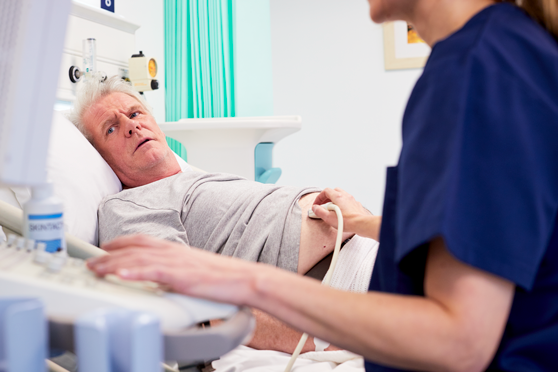
If these tests are not normal, you will go to a specialist. The specialist will repeat the tests the GP has done. The specialist will want you to have a scan using sound waves – a rectal ultrasound. The ultrasound probe goes into your back passage to get a clear picture of the prostate gland. This is uncomfortable, but shouldn’t hurt.
You may have tissue samples (biopsies) taken during the scan. Your specialist takes the samples by firing a very small needle into the prostate. This is a little uncomfortable, and may be painful but it does not take long. You will feel a slight jolt each time the needle is fired. Before the test, you will have antibiotics to help prevent infection and an injection of local anaesthetic to numb the area.
Usually you begin by seeing your family doctor (GP) who will examine you and ask about your general health. There are several tests that may be used to diagnose prostate cancer.
PSA is a protein produced by both normal and cancerous prostate cells. A high level of PSA can be a sign of cancer, but your PSA level can also be raised in prostate conditions that are not cancer (are benign), or if you have an infection. To check for PSA (prostate specific antigen), your doctor takes a sample of your blood. Your doctor may want to rule out a urine infection before carrying out a test. If you've had a urine infection, you shouldn't have a PSA test for at least a month after your treatment finishes. PSA is usually measured in nanograms per millilitre of blood (ng/ml).
There is no one PSA reading that is considered 'normal'. The reading varies from man to man and the normal level increases as you get older. But the following values are a rough guide
- 3 ng/ml or less is considered to be in the normal range for a man under 60 years old
- 4 ng/ml or less is normal for a man aged 60 to 69
- 5 ng/ml or less is normal if you are aged over 70.
A reading higher than these values, but less than 10 ng/ml is usually due to a benign enlarged prostate. A reading higher than 10 ng/ml may also just be benign prostate disease, but the higher the level of PSA, the more likely it is to be cancer. Sometimes a cancer may be diagnosed in a man with a 'normal' PSA reading. But usually, the higher the reading, the more likely it is to be cancer. Some men have PSA levels in the hundreds (or even thousands) when they are diagnosed. The higher the level of PSA at diagnosis, the more likely the cancer is to spread quickly. There is more information about the PSA blood test in the section on screening for prostate cancer.
PSA blood tests are also used to monitor how well prostate cancer treatment works or to decide whether you need treatment. If your PSA is stable, it is a sign that a cancer is not growing or spreading. Successful treatment shrinks cancer and so the PSA level in the blood then falls.

Your doctor puts a gloved finger into your back passage (rectum) to feel your prostate gland and check for abnormal signs, such as a lumpy, hard prostate. Doctors call this test a digital rectal examination (DRE).
You may also have a a rectal ultrasound to examine the prostate gland. You will need to make sure you have had a bowel movement beforehand so your rectum is empty when you go for your appointment. A small ultrasound device is put into your back passage. It produces sound waves to create a clear picture of the prostate gland. This test is uncomfortable, but shouldn't hurt. It does not take long.
If a lump or hardening of your prostate is found during your rectal examination, your specialist may take a sample of cells (a biopsy) to examine under a microscope. The biopsy is most often done through your back passage (rectum) using a transrectal ultrasound scanner. But you can also have a biopsy taken through the skin behind your testicles (the perineum) or while you are having a cystoscopy examination.
You have the biopsy in the outpatient department. When you arrive at the hospital, you will be met by a nurse, who will ask you some questions and make sure you understand what will happen. Before the biopsy, you may have blood taken for a repeat PSA test. You will be given antibiotics to help stop infection developing after the biopsy. You can have antibiotics in 3 different ways - as tablets or capsules, by injection into a vein, or directly into the rectum in a suppository.
Before you have the biopsy, you will be shown the ultrasound and the very fine needle used to take the tissue samples. The needle is attached to a firing mechanism and the doctor will show you this and demonstrate the noise it makes so you know what to expect.
To have the biopsy, you lie down on your left side. Your specialist will inject local anaesthetic into your back passage (rectum) first, to numb the area and make the procedure as painless as possible. The doctor then puts the rectal ultrasound probe into your rectum to examine your prostate. To get the sample of prostate tissue, the fine needle is put along the ultrasound probe and into the prostate gland. This is a little uncomfortable, and may be painful but does not take long. You will feel a slight jolt each time the needle is fired.
After the test, you have a rest and a drink. You can then go home. It is very important to drink a lot of fluids for the next 24 hours. Your prostate gland will bleed slightly. And there is a risk of urine infection. Drinking plenty will flush out the blood and help to stop any infection from developing. You will see a small amount of blood in your urine and semen after the test. This may carry on for a few weeks, but is nothing to worry about. But you should contact your doctor if you think you are getting an infection.
You should phone your doctor immediately or go to casualty if you have
- Shivering or shaking
- A high temperature
- A lot of difficulty passing urine
- To pass urine very often
- A lot of blood in your urine or bowel movement
You will need antibiotics straight away if you have a urine infection.
The PCA3 test is new. Doctors hope it will help them decide who may have prostate cancer and need to have a biopsy. PCA3 stands for Prostate CAncer gene 3. Prostate cells have PCA3 genes. These genes make the prostate cells produce a small amount of a particular protein. Prostate cancer cells make much more of this protein than normal cells. When the level of PCA3 protein is high, it leaks into the urine. So the level of this protein can be measured by a urine test. We don't yet know how useful this test will be, and you can't have it on the NHS. But so far, trial results have been promising, and it may be used more often in the future.
If your GP finds anything that could be due to a cancer you will be referred to hospital for further tests. These tests are used to diagnose prostate cancer but you don't need to have all of them. Your doctor will discuss the tests you'll have beforehand and explain what they are for.