Womb cancer tests
This page tells you about tests to diagnose womb cancer. There is information on
Womb cancer tests
You will usually see your family doctor first, who will ask you about your general health and examine you. If you have symptoms that may be caused by womb cancer, your GP may ask about your family history of cancer. Your doctor may ask you to give blood and urine samples for testing. Your GP will probably then do a pelvic examination (sometimes called an ‘internal’). You may also have a cervical smear.
At the hospital
If your doctor is at all concerned, he or she will ask you to go to the hospital for tests. The only way to definitely diagnose womb cancer is to take a sample of the tissue lining the womb. Your doctor will call this an endometrial biopsy. The tissue goes to the lab, where it is closely checked for cancerous cells, or cells that look abnormal in any way. There are different ways to take these biopsies. You might have an aspiration biopsy, a hysteroscopy or a ‘D and C’. Further down this page, there is information about the different ways of having a biopsy and other tests you may have.
While you are waiting for results, it may help to talk to a close friend or relative about how you are feeling. Or you may want to contact a support group to talk to someone who has been through similar experiences.
You can view and print the quick guides for all the pages in the Diagnosing womb cancer section.
If you have any health worries, you will usually see your family doctor first, who will ask you about your general health and examine you. If you have symptoms that may be caused by womb cancer, your GP may ask about your family history of cancer. Your doctor may ask you to give blood and urine samples for testing.
Your GP will probably then do a pelvic examination (sometimes called an ‘internal’) to check your womb, vagina, ovaries, bladder and rectum (back passage). You lie on your back on a couch with your feet drawn up and your knees apart. Your doctor will then put one or two gloved fingers into your vagina and at the same time press down on your abdomen with the other hand. The doctor will feel for any lumps or changes in size or shape. If any part of your reproductive system is enlarged, or if a lump of any kind is there, the doctor should be able to feel it.
Your GP may then use an instrument called a speculum to spread the vaginal walls and examine your cervix, to see if it looks normal. You may also have a cervical smear taken - a quick procedure that should only be uncomfortable for a moment at most. The whole internal examination shouldn’t take much more than five minutes.
If your doctor is at all concerned, they will ask you to go to the hospital for tests. At the hospital, you may have any of the following tests
The only way to definitely diagnose womb cancer is to take a sample of the tissue lining the womb. Your doctor will call this an endometrial biopsy. The tissue is sent to the lab, where it is closely checked for cancerous cells, or cells that look abnormal in any way. There are different ways to take these biopsies. You might have an
Aspiration biopsy
The doctor puts a long thin plastic tube (called a pipelle) into the womb through the vagina and gently sucks cells into it using a syringe. Most women can have this procedure done while they are awake. It should only take a few minutes. You may have period type pains during or after this test, but mild painkillers should help to control that.
Hysteroscopy
This test uses a fine telescope, called a hysteroscope, to look into your womb and take a biopsy. You can have this test as an outpatient, and it should only take a few minutes.
To have this test you lie on a couch and the doctor will open your vagina with a speculum. This is just the same as the doctor would do when you have a smear test. Your doctor will put local anaesthetic around your cervix (neck of womb) to reduce any discomfort you may have during the test. Then the doctor passes the hysteroscope through your cervix into your womb. The doctor will put fluid or gas through the hysteroscope to inflate the womb a little and make it easier to see inside. The doctor will examine your womb and take a sample of the lining. During this test and afterwards you might have some cramping ‘period type’ pains. You may also have some bleeding which lasts a few days.
D and C (dilatation and curettage)
You may need to have a ‘D and C’ so your doctor can get enough tissue for testing. You have this done while you are asleep (under general anaesthetic) in hospital. During this procedure the doctor gently opens up the entrance to the womb (the cervix) and scrapes off samples of the womb lining with a small spoon-like instrument called a curette. The tissue samples go to the laboratory to be examined under a microscope.
You will stay in hospital for at least a few hours after a ‘D and C’ to recover. As you will have had a general anaesthetic, your doctor may want you to stay overnight.
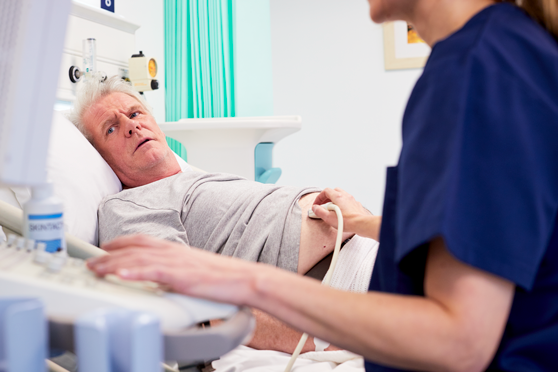
Your doctor may suggest an ultrasound scan. This test can show how thick the lining of the womb is. During the test, the radiographer or doctor will also check your other pelvic organs.
You usually have the ultrasound probe put inside your vagina. This is called a transvaginal ultrasound. It may feel uncomfortable but should not hurt. Or you might have the probe on your tummy (abdominal ultrasound). Sometimes your doctor may ask you to have both types of ultrasound.
If you have had your menopause and the thickness of your womb lining is more than 5mm, you will need further tests. If the thickness of the womb lining is 5mm or less in a woman who has had her menopause, womb cancer is unlikely. It cannot be completely ruled out, but your doctor is unlikely to go on to take a biopsy unless you have other symptoms (such as irregular vaginal bleeding).
You may have blood tests for CA125. This is a ‘tumour marker’. A tumour marker is a chemical given off by cancer cells. It gets into the bloodstream and so can be picked up in a blood test. CA125 levels are often raised in cancer of the ovary. The blood levels of CA125 are raised in some women with womb cancer, but not all. If you have raised CA125 levels in the blood it does not necessarily mean you have womb (or ovarian) cancer. CA125 can also be raised in a number of other conditions, including fibroids.
Sometimes blood tests can show that you are suffering from anaemia (low blood iron content) because you are losing blood from abnormal or heavy vaginal bleeding.